

Many organizations today are investing heavily in digital transformation initiatives. Yet, a large percentage of these initiatives fail to deliver measurable business impact.
The problem is rarely the technology itself. Instead, failure often comes from unclear direction, fragmented execution, and resistance to change.
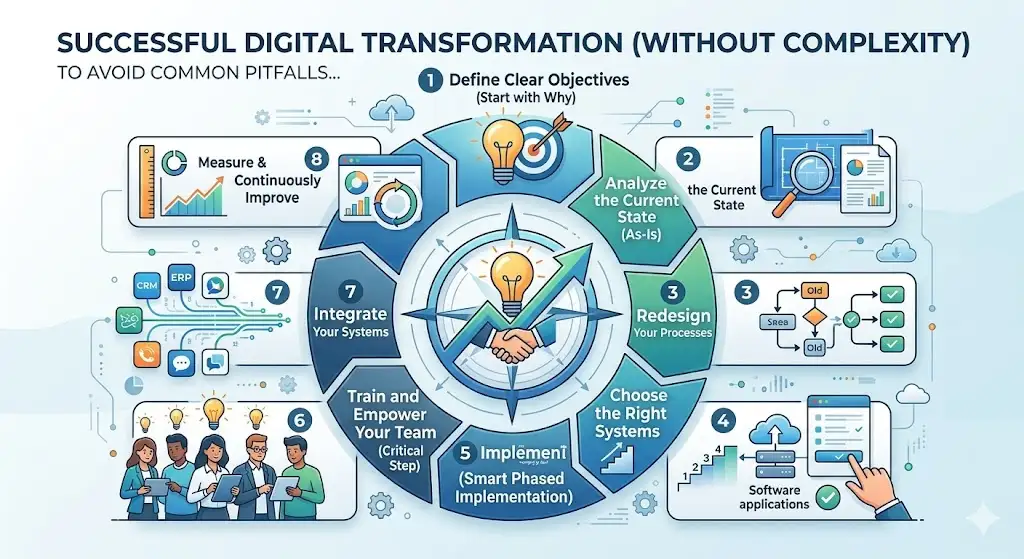
This article presents a structured and practical approach to digital transformation focused on results, not complexity.
1. Start with Business Outcomes, Not Technology
Successful digital transformation begins with clarity.
Rather than asking “Which system should we implement?”, organizations should ask:
- What business outcomes are we trying to achieve?
- What problems are we solving?
- What does success look like in measurable terms?
Defining outcomes early ensures that technology becomes a tool—not a distraction.
2. Understand Operational Reality
Before introducing change, it is essential to understand how work actually happens inside the organization.
This involves:
- Mapping current workflows
- Identifying bottlenecks
- Understanding dependencies between departments
Without this visibility, any transformation effort risks addressing symptoms instead of root causes.
3. Fix Before You Automate
Digitizing inefficient processes only makes problems scale faster.
A more effective approach is to:
- Simplify workflows
- Eliminate unnecessary steps
- Standardize operations
Only then should automation and digital tools be introduced.
4. Align Technology with Business Needs
There is no “one size fits all” solution.
Organizations typically consider:
- ERP platforms to unify operations
- CRM systems to manage customer interactions
- Data tools to improve decision-making
The key is alignment not popularity. The right system is the one that fits your operational model.
5. Execute in Controlled Phases
Large scale implementations often fail due to complexity.
Instead:
- Prioritize high impact areas
- Deliver quick wins
- Expand gradually
A phased approach improves adoption and reduces operational disruption.
6. Focus on Adoption, Not Just Deployment
Implementing a system is easy. Ensuring people use it correctly is the real challenge.
To drive adoption:
- Provide role based training
- Define clear usage policies
- Monitor engagement and usage levels
Transformation succeeds when people change how they work—not just when systems are installed.
7. Build an Integrated Ecosystem
Disconnected systems create fragmented data and poor decision-making.
An effective digital environment ensures:
- Seamless data flow between departments
- Consistent information across systems
- Real-time visibility for leadership
Integration turns systems into a unified business platform.
8. Treat Transformation as an Ongoing Capability
Digital transformation is not a one-time initiative.
Organizations should:
- Continuously evaluate performance
- Adapt processes as the business evolves
- Upgrade systems when needed
Sustainable success comes from continuous improvement not one-time execution.
Digital transformation is not defined by the systems you implement, but by the way your organization evolves.
The companies that succeed are not those with the most advanced tools, but those with the clearest strategy and strongest execution.
If you are exploring digital transformation within your organization, a structured approach can significantly reduce risk and improve outcomes.